
The Patina of Use
A study of hide, hand-stitching and the patient work that gives leather its character and lasting patina.
THE CHARACTER OF HIDE
Leather is a responsive material whose strength, grain, flexibility and ageing behaviour vary with animal, cut, tanning method and finish. Successful work begins with accurate assessment of temper, thickness, surface and intended service conditions.
ORIGINS
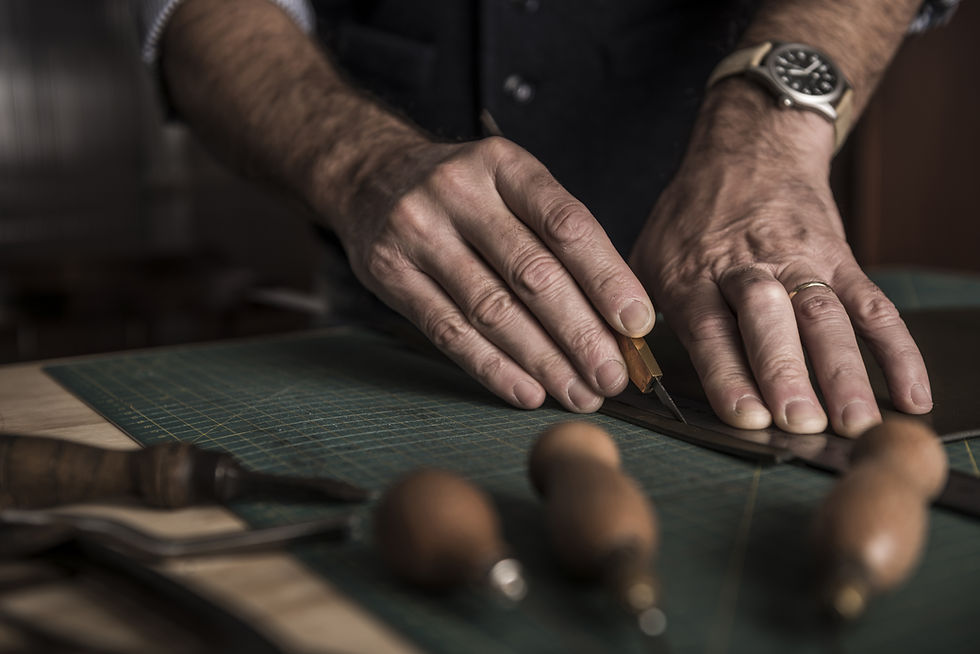
Leatherworking is among the oldest material practices, emerging wherever people learned to preserve hide and make it useful. Its history is inseparable from clothing, shelter, transport and domestic life: leather became footwear, harness, vessels, book covers and furniture. Across Britain and Europe, the craft developed through specialist trades, from saddlery and shoemaking to glove making, upholstery and casework. Industrial production introduced mechanised cutting, splitting and stitching, yet hand methods remained essential where accuracy, repair and individual commission mattered. Contemporary leatherworking is therefore neither purely traditional nor simply industrial; it is a continuum in which inherited knowledge is tested against new materials, machinery and design requirements.
THE STITCH
Saddle stitching remains fundamental because it creates a durable mechanical relationship between layers. Pricking irons establish rhythm and spacing, while skiving, grooving and edge finishing serve more specific structural or visual purposes. Tension, thread choice and the direction of the grain matter as much as the stitch name.
MATERIALS
Material selection is a design and engineering decision. Vegetable-tanned leather develops depth and patina; chrome-tanned leather offers softness and consistent colour; suede and exotic finishes create different tactile effects. The maker must also account for hide quality, thickness, stretch, moisture, provenance and the long-term service of the finished piece.


TECHNIQUE AND CONTEMPORARY LEATHERWORKING
Modern workshops combine hand tools with machinery, laser cutting and measured finishing systems. Technology improves repeatability, but it does not replace judgement: edges, seams, surface preparation and final finishing still determine whether a piece is merely manufactured or properly made.
NOTABLE STUDIOS
A curated look at leatherworkers and houses working across traditional saddlery, responsible materials and contemporary design.
Swaine
A historic British leather goods house known for refined craftsmanship, traditional materials and a long relationship between utility and elegance.
Billy Tannery
A British leather company known for pioneering goat leather production, combining responsible sourcing with a contemporary approach to traditional craft.
Ettinger
A heritage British leather goods maker recognised for refined wallets, cases and accessories rooted in traditional manufacturing and understated design.
Tusting
A family-owned British maker best known for leather bags and travel goods that balance practical durability with restrained design.
Charles Laurie London
Specialists preserving historic leatherwork through research, careful intervention and respect for the original maker’s intent.
Crowson London is not affiliated with, endorsed by, sponsored by, or otherwise connected to any house or studio named here, unless expressly stated. Names and trademarks belong to their respective owners.